
Use AI Without Getting Hacked, Sued, or Replaced
Your team is already using AI. This free guide shows you how to make sure it’s helping your business, not quietly putting your data, your customers, and your reputation at risk.
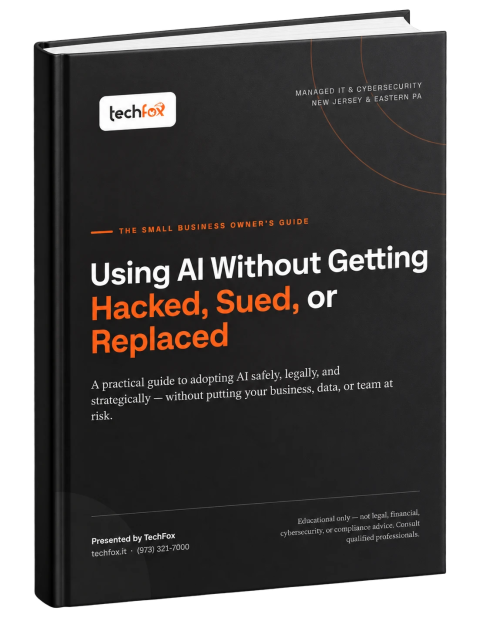
- Spot the hidden AI risks already inside your business
- Keep client and company data out of public AI tools
- Set clear, simple rules for how your employees use AI
- Includes a 17-point AI Security & Governance Checklist
Get your free copy
Enter your information below to get instant access to the guide.
Instant download. No cost, no sales pitch. We’ll never sell or share your information.
Your team is already using AI. The question is whether it’s on your terms.
Chances are someone in your business used AI this week to draft an email, summarize a document, clean up a spreadsheet, or answer a customer faster. That isn’t something to fear. It’s something to manage.
The businesses that get into trouble with AI are rarely the ones that use it. They’re the ones that use it without structure. It usually looks harmless in the moment:
- A salesperson pastes confidential prospect notes into a free chatbot.
- Finance uploads a full profit-and-loss statement into an unapproved tool.
- HR uses AI to screen resumes with no check for bias.
- Marketing publishes AI-written claims nobody fact-checked.
The three AI fears every owner has, and why each one is manageable
The most common exposure isn’t a dramatic breach. It’s an employee pasting a password, a client list, or a proprietary document into a free AI tool that was never vetted. Meanwhile, attackers use AI to write cleaner phishing emails and clone voices to authorize payments.
AI writes confident, polished text, and that text can contain inaccurate claims, copyrighted material, privacy violations, or biased language. The danger is treating it as finished work. Regulated industries carry even more exposure.
The near-term threat isn’t that AI replaces your people. It’s that a competitor’s AI-enabled team outperforms a business that never adapted.
The guide shows you exactly where each risk comes from, and the simple guardrails that shut it down.
A practical playbook, not a tech manual
15 short chapters written for business leaders, not IT departments. Read it straight through in one sitting, or jump to what you need.
What your policy needs to cover, plus a simple 5-tier way to classify your data so everyone knows what can and can’t go into an AI tool.
A 3-tier system that matches human review to the level of risk, so low-stakes work moves fast and high-stakes decisions stay with a person.
Find out whether a tool trains on your data, logs activity, and protects what you delete, before it touches your systems.
Deepfakes, voice cloning, fake invoices, malicious “AI” apps, and the practical protections that stop them.
Safe, high-value starting points for leadership, sales, marketing, customer service, operations, finance, HR, and IT.
A quick self-assessment across policy, security, legal, training, and governance.
Assess, protect, pilot, govern, and scale, at a pace that fits your business.
Can you check these three boxes today?
If you hesitated on any of them, you’re not alone, and this guide was written for you. The full checklist has 17 points and takes about five minutes.
Built for leaders who don’t have time to become AI experts
- Owners and executives who want AI’s productivity gains without the liability
- Leaders in regulated fields such as healthcare, finance, legal, and manufacturing
- Managers whose teams are already experimenting with ChatGPT, Copilot, or Gemini
- Anyone who has to answer the question, “Are we allowed to use AI for this?”
From the team that helps growing businesses adopt technology securely
Since 2001, TechFox has helped small and mid-sized businesses across New Jersey and Eastern Pennsylvania put technology to work without putting their data, customers, or team at risk. Founder Marc Caruso is the author of Unhackable IT, a Zero Trust playbook for business leaders. This guide applies the same principle to AI: clear rules, sensible guardrails, and no blind trust.
Before you download
Yes. There’s no cost and no obligation.
No. It’s written for owners and managers, in plain language.
15 short chapters you can read in one sitting, plus a checklist you can finish in minutes.
You’ll go straight to a page where you can download the guide. We may follow up with helpful resources, and you can unsubscribe anytime.
AI rewards the businesses that adopt it deliberately.
Get the framework to lead it with confidence: what to allow, what to protect, and where to start.
This guide is for general educational purposes only and is not legal, financial, cybersecurity, or compliance advice. Consult qualified professionals before acting on it.